
UCHELOLAU CHURCH
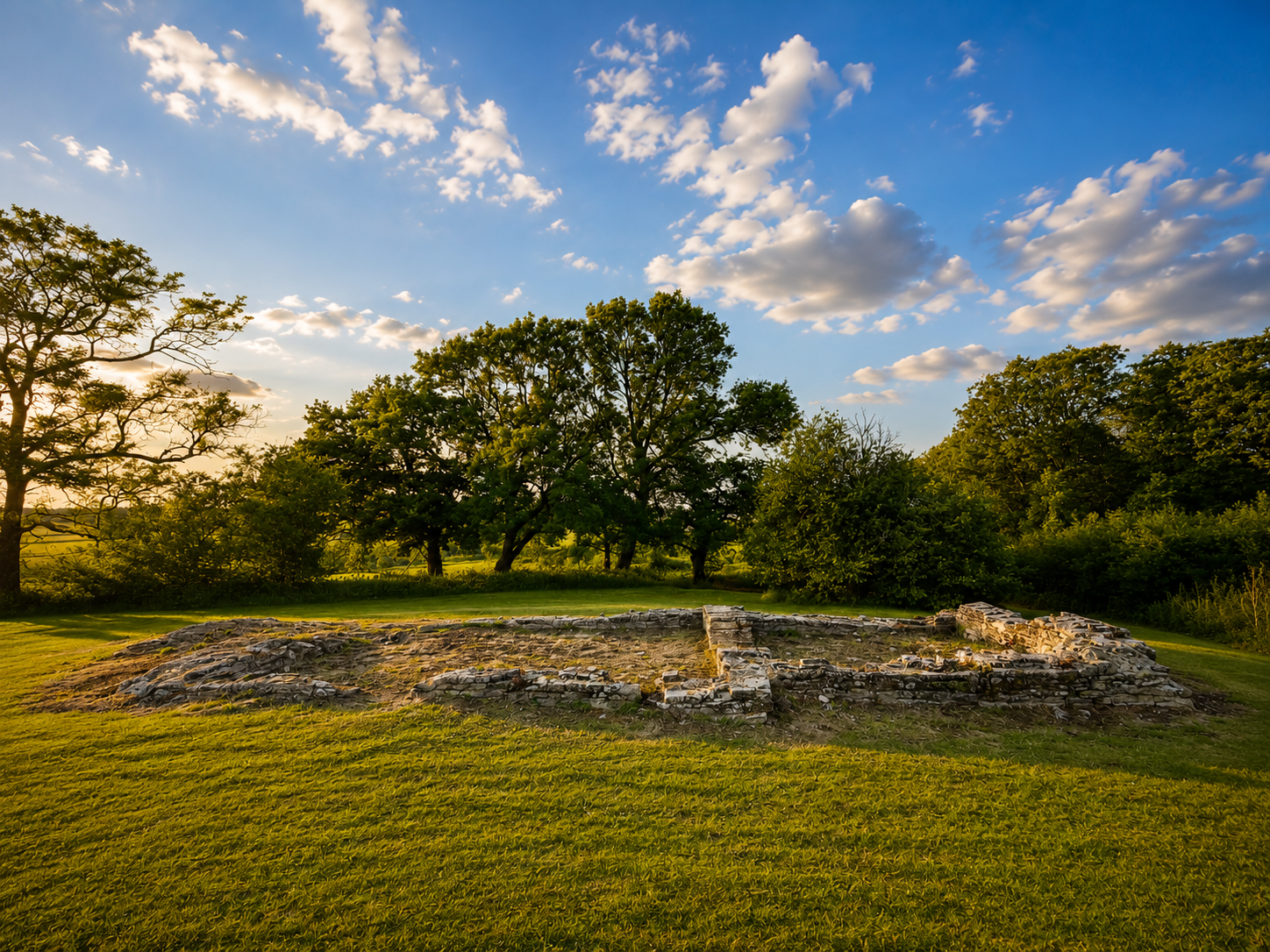
The remains of Uchelolau Church (also known historically as Highlight Church) are one of the most historically significant features at Brynhill Golf Club. Although only the foundations remain today, they represent a medieval church that stood on the site for around 350–400 years.
The history of Uchelolau Church
The church is believed to have been constructed during the late 12th or early 13th century, serving the small medieval settlement of Highlight (Uchelolau), a village that once occupied the surrounding land before disappearing over time.
Archaeological excavations carried out between 1964 and 1966 uncovered the stone foundations that visitors see today. During the excavation, archaeologists discovered:
The complete footprint of the church.
A rectangular nave measuring approximately 7.5 metres by 5 metres.
A smaller eastern chancel measuring around 5 metres by 3.5 metres.
Fragments of red decorative plaster, suggesting that parts of the interior walls were painted—quite a prestigious feature for a small medieval church.
The church appears to have been abandoned around 1570, during the religious upheavals following the Reformation in the reign of Elizabeth I. The surrounding medieval village also disappeared, leaving only the church foundations behind.

From the Archive features a photograph of the members of the Barry and Vale Archaeological Group (BVAG) taken in September 1966.Why is it protected?
The church is protected as a Scheduled Monument, which is the highest level of legal protection available for an archaeological site in Wales.
Its official designation is:
Name: Highlight Church, Remains of
Cadw Reference: GM344
Scheduled since: 21 August 1973
Cadw considers the site to be of national importance because it has the potential to teach us about:
Medieval Christianity in South Wales.
Medieval building techniques.
Village life during the Middle Ages.
The relationship between churches and rural settlements.
Even though only the foundations survive, valuable archaeological evidence still exists beneath the ground.
Who protects it?
The monument is protected by Cadw, the Welsh Government's historic environment service.
Cadw:
Maintains the national register of Scheduled Monuments.
Advises owners on conservation.
Controls any work carried out on the site.
Can prosecute anyone who damages a Scheduled Monument without permission.
Although the land is part of Brynhill Golf Club, the monument itself is protected under Welsh heritage legislation.
What does this protection mean?
Without obtaining Scheduled Monument Consent from Cadw, it is generally illegal to:
Dig within the protected area.
Alter the stonework.
Build on or over the site.
Plant trees whose roots could disturb archaeology.
Install fencing, drainage or interpretation boards that disturb the ground.
Carry out landscaping or earthworks.
Use metal detectors.
Routine grass cutting is generally acceptable because it does not disturb the archaeology below ground.
A fascinating feature for Brynhill
Few golf courses can claim to have a protected medieval church dating back over 800 years within their boundaries.
It provides Brynhill with a unique historical story that complements the golf course and offers visitors something few clubs can match—a tangible link to medieval Wales. The church stands as one of the last visible reminders of the lost medieval settlement of Highlight (Uchelolau), making it an important cultural landmark as well as an archaeological one.
It adds another dimension to the Brynhill experience, showing that the course offers not only excellent golf but also a remarkable piece of Welsh history.
Located between the walk from the 13th green to the 14th tee. Next time your playing stop for a closer look, not many golf courses can boast of a medieval church on its grounds.